


Choosing the wrong grating material is a costly mistake. Not just in terms of replacement expenses, but also in safety risks, unplanned downtime, and the frustration of fixing something that should have been right the first time. If you are a procurement manager or project engineer trying to figure out whether to go with MS, GI, or FRP grating for your next project, this guide is written specifically for you.
We will break down each material honestly, tell you where each one performs well, where it does not, and give you a practical way to decide without having to sit through a sales pitch.
What Each Material Actually Is
Most buyers already know the names. MS grating. GI grating. FRP grating. But the differences go deeper than just the label, and understanding them helps you make a smarter purchase.
MS Grating
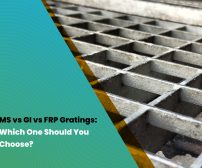
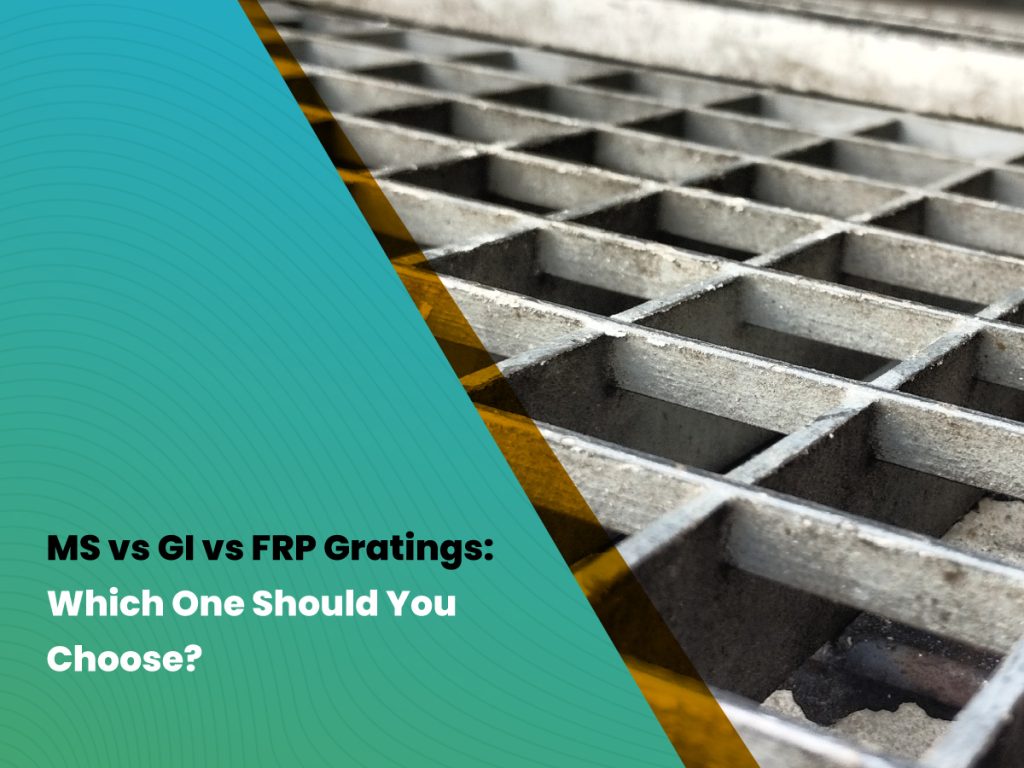
MS Grating stands for Mild Steel Grating. It is made from low-carbon steel bars that are either welded or electroforged into a grid pattern. It is the oldest and most commonly used type of industrial grating in India, particularly in manufacturing plants, structural platforms, and heavy engineering facilities. Strength is where MS grating truly shines. It can handle serious loads without flexing or failing. The trade-off is that it rusts. Without a protective coating like paint or epoxy, moisture will damage it, sometimes faster than you expect.
GI Grating
FRP Grating is essentially MS grating that has gone through a hot-dip galvanising process. The fabricated grating is dipped into a bath of molten zinc at roughly 450 degrees Celsius. The zinc bonds metallurgically to the steel surface, covering every angle, edge, and interior section. This is not just a coat of paint. It is a layer that becomes part of the metal itself. The result is much better corrosion protection than any paint system, and it lasts significantly longer in outdoor or moderately humid conditions.
FRP Grating
FRP Grating is a completely different category of material. it stands for Fibre Reinforced Plastic. It is manufactured by combining fibreglass strands with a resin, typically polyester, vinyl ester, or phenolic. The result is a composite material that is light, strong for its weight, and naturally resistant to corrosion without any coating. FRP grating comes in two manufacturing types. Moulded FRP is produced in a grid mould and has equal strength in both directions. Pultruded FRP is pulled through a die and has higher load capacity in one direction. Neither type will rust, corrode, or conduct electricity.
The Honest Comparison: MS vs GI vs FRP Gratings
| Property | MS Grating | GI Grating | FRP Grating |
| Base Material | Mild Steel | Zinc-coated Steel | Fibreglass and Resin |
| Corrosion Resistance | Poor without coating | Moderate to Good | Excellent, no coating needed |
| Structural Load Capacity | Highest | High | Moderate to High |
| Weight | Heavy | Heavy | About 25 percent of steel |
| Purchase Cost | Lowest | Mid-range | Higher upfront |
| Maintenance Over Time | Frequent and costly | Occasional | Practically none |
| Realistic Service Life | 5 to 10 years in wet zones | 15 to 25 years | 25 years and beyond |
| Electrical Safety | Conductive | Conductive | Non-conductive |
| Best Suited For | Dry indoor, high-load areas | Outdoor general industrial | Chemical, coastal, ETP, Oil and Gas |
These figures are based on general field experience and industry practice. Actual performance depends on your specific site conditions, maintenance discipline, and the quality of fabrication.
MS Grating: Where It Fits and Where It Does Not
There is a reason MS grating has been the go-to choice in Indian industry for decades. It works. In the right conditions, nothing else matches it on cost and load capacity.
A heavy engineering plant with a dry fabrication shop floor, high overhead cranes, and a team that repaints every two to three years is the ideal setting for MS grating. The environment keeps corrosion manageable, the loads are high, and the budget is tight. MS grating delivers exactly what is needed in that situation.
Where it starts to fail is when water gets involved. Platform areas near cooling towers, open-sided sheds in high-rainfall regions, washing bays, or any surface that sees regular water contact will eat through MS grating faster than most people expect. A project engineer once told us his plant replaced an MS grating platform near their rinsing section three times in eight years before finally switching to FRP. Each replacement cost more than the last because of the additional labour, downtime, and structural inspection work involved.
MS grating is a good choice when:
- Your facility is indoors with controlled or dry conditions
- Load requirements are heavy and structural strength is the priority
- You have a committed maintenance schedule that includes repainting
- Budget constraints make the lower upfront cost necessary
Think carefully before using MS grating when:
- The area sees regular water, steam, or chemical splash
- The installation is outdoors in a humid or coastal region
- Maintenance resources are limited or irregular
- The cost of replacing the grating early will cause operational disruption
GI Grating: The Middle Ground That Often Gets Overlooked
GI grating sits between MS and FRP in almost every way. Better corrosion protection than MS. Lower cost than FRP. Adequate load capacity for most general industrial applications. It is a practical, reliable option that does not get as much attention as it deserves.
The hot-dip galvanising process is what makes the difference. Unlike paint, which sits on the surface and peels over time, zinc bonds to the steel at a molecular level. Scratches and minor damage do not lead to immediate rust because the surrounding zinc acts as a sacrificial layer, corroding instead of the steel beneath it. That self-healing quality is one of the reasons GI grating lasts 15 to 25 years in outdoor industrial environments with very little upkeep.
An automotive components manufacturer in the Pune belt installed GI grating on all their outdoor access platforms and rooftop walkways about a dozen years ago. Today, those gratings still look structurally sound with only some surface discolouration. The comparison with their older MS platforms, which had to be partially replaced within six years, is stark.
GI grating is a good choice when:
- The installation is outdoors and exposed to weather, rain, or humidity cycles
- You need better corrosion protection than MS without stepping up to FRP pricing
- The application involves general industrial walkways, stairways, or mezzanine platforms
- Load requirements are high but the environment is not chemically aggressive
GI grating is not the right call when:
- Your environment involves strong acids or alkalis. Zinc dissolves at pH extremes and once the coating is gone, you are left with unprotected steel
- Chemical splash from chlorine-based compounds, concentrated solvents, or acid wash is a regular occurrence
- Electrical insulation is required for safety compliance
- You are in a direct marine spray zone where chloride levels are very high
FRP Grating: Built for the Environments That Destroy Everything Else
FRP grating is not the cheapest option and it is not meant to be. It is engineered for the situations where MS and GI simply cannot last. Chemical plants, ETPs, coastal industrial sites, Oil and Gas processing facilities, and electrical substations are where FRP truly earns its keep.
The material does not rust. It does not corrode when exposed to most acids, alkalis, and organic solvents. It does not conduct electricity. And it weighs around a quarter of what an equivalent steel grating would weigh, which matters enormously during installation on elevated platforms where lifting equipment costs add up quickly.
A textile unit running an effluent treatment plant in Gujarat switched their entire platform grating from MS to moulded FRP after repeated corrosion failures. The initial cost was higher by a noticeable margin. But in the years since, they have spent nothing on grating maintenance. No repainting, No replacement panels, and No structural inspections triggered by rust-through. The return on that investment showed up within three to four years, and it continues to compound.
FRP grating is the right choice when:
- Your environment involves chemical exposure, acid splash, alkali fumes, or solvent contact
- The installation is in an ETP, STP, cooling tower basin, or chemical processing area
- You are working in a coastal or marine environment with high salt and humidity exposure
- Electrical safety requirements make non-conductive flooring necessary
- The platform is at height, and lightweight material reduces installation cost and risk
- You need a food-grade or pharmaceutical-grade hygienic surface compliance
- The installation is a solar rooftop walkway or any application where long, maintenance-free service is the goal
FRP grating has limitations too:
- Very heavy concentrated loads, such as forklift traffic or crane access areas, require careful engineering review. Standard moulded FRP may not be adequate and you may need pultruded grades or steel instead
- High-temperature process areas above 100 to 120 degrees Celsius are not suitable for standard polyester resin FRP. You would need vinyl ester or phenolic resin grades which come at a further cost premium
- On-site cutting requires the right blades and proper dust controls for fibreglass particles
- The higher purchase cost requires lifecycle thinking to justify, which not all project budgets accommodate
The Lifecycle Cost Question
Procurement decisions in industrial facilities rarely happen in isolation from finance. Capital expenditure has to be approved, and the cheaper option often wins on paper. But here is the thing about grating selection: the purchase price is just the beginning.
Consider a moderately corrosive outdoor platform covering 500 square metres. MS grating may need repainting every two to three years and partial replacement by year six to eight. Over 20 years, the combined cost of material, labour, and downtime can easily reach two to three times the original purchase price.
GI grating in the same scenario might go 15 years with minimal maintenance, bringing the total cost to perhaps 1.3 to 1.5 times the original investment.
FRP grating starts higher, but in a genuinely corrosive environment, you may spend almost nothing on maintenance over the same 20-year period. The total cost of ownership frequently ends up lower than GI by year 12 to 15.
This is why experienced plant heads in chemical, pharma, and Oil and Gas facilities have largely moved away from MS and GI grating in corrosive zones. The logic is simple once you run the full numbers.
Which Grating Should You Choose? A Practical Decision Guide
| Your Situation | Recommended Choice |
| Indoor manufacturing plant, dry, heavy loads, tight budget | MS Grating |
| Outdoor walkways and platforms, general industrial exposure | GI Grating |
| Chemical plant, acid or alkali environment | FRP Grating |
| Effluent Treatment Plant or Sewage Treatment Plant | FRP Grating |
| Coastal or marine industrial installation | FRP Grating |
| Oil and Gas facility, onshore or offshore | FRP Grating |
| Electrical substation or switchyard | FRP Grating |
| Food processing or pharmaceutical production area | FRP Grating |
| Solar rooftop walkway or similar outdoor long-life application | FRP Grating |
| Heavy vehicle or forklift access platform | MS Grating, heavy-duty specification |
| Mixed facility with dry zones and wet zones | Zone-wise hybrid of MS, GI, and FRP |
For large facilities with multiple environments, a hybrid approach is often the most cost-effective answer. You do not have to use one material throughout. Experienced fabricators can help you map each zone to the right grating type, which typically delivers better value than applying a single material across the entire site.
Key Takeaways
- MS grating is the strongest and most affordable option, but needs regular maintenance and is not suited for wet or chemical environments
- GI grating offers genuine corrosion protection through hot-dip galvanising and performs well in outdoor industrial conditions for 15 to 25 years
- FRP grating is the material of choice for chemical plants, ETPs, coastal sites, Oil and Gas, and electrical hazard areas, with a service life of 25 years and above
- Never evaluate a grating based on purchase price alone. Maintenance, repainting, replacement, and downtime costs over 15 to 25 years often change the decision entirely
- Match your material selection to the worst condition your installation will face, not the average condition
Frequently Asked Questions
Q1. What is the main difference between MS and GI grating?
MS grating is plain mild steel with no protective coating. GI grating is the same base metal but treated through hot-dip galvanising, which bonds a zinc layer to every surface. This zinc coating provides significantly better corrosion resistance and a longer service life, especially in outdoor or humid conditions. The zinc also has a self-healing quality that paint does not, meaning small scratches do not immediately lead to rust.
Q2. Which grating is best for corrosion resistance?
FRP grating offers the best corrosion resistance of the three. It does not rust, corrode, or degrade when exposed to most acids, alkalis, and solvents because the material itself is non-metallic. GI grating provides good corrosion resistance through its zinc coating but has limits in aggressive chemical environments. MS grating has the lowest corrosion resistance without additional protective treatment.
Q3. Is FRP grating strong enough for industrial use?
Yes, for most industrial applications. Pultruded FRP grating, in particular, can carry substantial loads and is used in Oil and Gas, chemical, and infrastructure applications globally. That said, for very heavy concentrated loads such as forklift bays or areas with heavy machinery access, you should have the load requirements reviewed by a structural engineer before specifying FRP. Steel grating remains the stronger choice for extreme load conditions.
Q4. Can you use GI grating in a chemical plant?
Not in areas with strong chemical exposure. Zinc, which is the protective layer in GI grating, dissolves when it comes into contact with strong acids or strong alkalis. Once the zinc is gone, the base steel underneath is exposed, and corrosion accelerates quickly. For chemical plants, FRP grating with the appropriate resin system is the right specification.
Q5. Why is FRP grating more expensive than MS or GI?
The manufacturing process for FRP involves combining fibreglass with specialty resins under controlled conditions. The raw materials and process cost more than steel fabrication or galvanising. However, in environments where FRP is appropriate, the near-zero maintenance requirement and longer service life frequently result in a lower total cost over a 15 to 25 year horizon compared to MS or GI.
Q6. Which grating works best for an ETP or STP?
FRP grating is the standard choice for Effluent Treatment Plants and Sewage Treatment Plants. The combination of continuous moisture, biological matter, and chemical effluents breaks down both MS and GI gratings relatively quickly in these environments. FRP resists all of these factors without needing any surface treatment, making it the most practical and long-lasting option.
Q7. Is FRP grating safe for outdoor use in coastal areas?
Yes. FRP grating is well-suited to coastal environments. Saltwater, high humidity, and corrosive sea air have minimal effect on the material. UV-stabilised grades are available for long-term sun exposure. This is one of the reasons FRP is used extensively in port facilities, coastal industrial platforms, and marine infrastructure projects.
About Earth Tech Engineering Works
Earth Tech Engineering is one of the reliable grating manufacturers in Gujarat, supplying MS, GI, and FRP gratings to industrial clients across manufacturing, chemical processing, infrastructure, and Oil and Gas sectors throughout India. Beyond grating supply, the company handles complete engineering fabrication works, including structural platforms, industrial stairways, handrails, ladders, and related access systems for new build and retrofit projects.
What makes working with Earth Tech different is the level of technical input that comes with every inquiry. Procurement managers and project engineers are not handed a catalogue and left to figure it out. The team reviews your site environment, load requirements, maintenance expectations, and project budget before recommending a material and specification. Whether you need MS grating for a heavy structural platform, GI grating for outdoor walkways, or FRP grating for a chemical or ETP application, the fabrication capability and material expertise are in place to deliver to the right specification, on time.
If you are evaluating grating options for an upcoming project or looking to replace ageing installations that have not performed as expected, Earth Tech Engineering is worth speaking to before you finalise your specification.
Request a Custom Quote for Your Grating Requirement
Tell us about your project, the environment, the load requirements, and the area you need to cover. Our technical team will come back with a clear recommendation and a detailed quote.